Honest CVs.
Real interview practice.
Paste your CV and a job description. Every claim in what comes back is checked against your CV before you see it. Then an interviewer built from the same job asks you the questions out loud, UK round by UK round.
Senior Backend Engineer with six years on payments systems in Python — distributed services on PostgreSQL and Kubernetes, with a figure behind each claim.
- Redesigned the payments service using PostgreSQL and event-driven queues, cutting checkout latency 40%.
- Led migration to Kubernetes, reducing deploy time from 25 minutes to under 3.
- Built internal tooling in Python to catch schema drift before it reached production.
- ✓PostgreSQL — Experience
- ✓Kubernetes — Experience
- ✓Python — Summary
- ✓Payments — Experience
- ✓Event-driven — Experience
- ✓Distributed systems — Summary
- ✓Backend — Title
- ✓Senior engineer — Title
- ✓Deployment — Experience
- ✓Latency — Experience
- ✓Schema — Experience
- ✓Internal tooling — Experience
- ✕GraphQL — not in your CV
- ✕Go — not in your CV
- ✕Kafka — not in your CV
A worked example — Jordan and Northwind are made up; the layout, the score and the lists are exactly what the tool produces.
You've got two options right now, and both cost you something.
The AI tools embellish
Ask one to tailor your CV and it'll add "Terraform" because the job wants it — never mind that you've never touched it. Fine, until an interviewer asks you a real question about it.
Doing it by hand works, but it's slow
Rewriting your CV properly for one role takes about an hour. You reread the job description, look for the right phrasing and reformat. Most people stop customising after the third application and start mass-applying with one generic version instead.
From one saved CV to the interview, in one place.
A free check before you use a tailored CV.
Paste a job description. We compare its requirements with your own answers. We count how many of its key words your CV has. We tell you if you have applied to this company before.
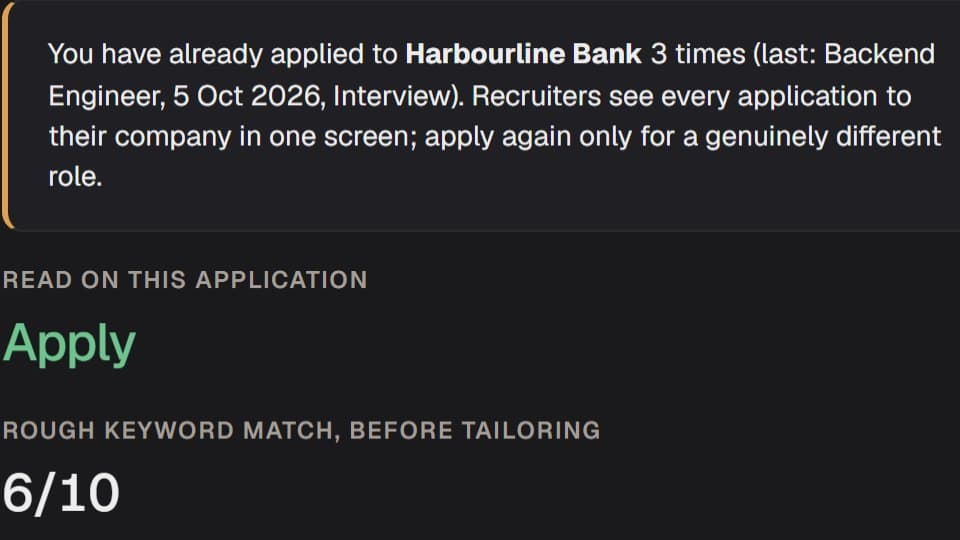
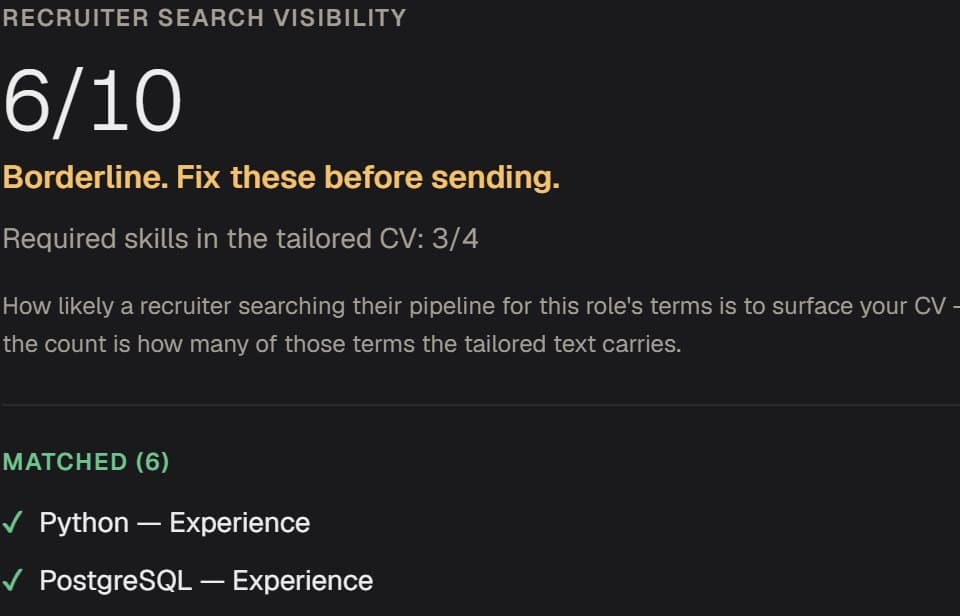
A tailored CV, and a score that is a count.
Summary, skills, experience and projects are selected from your own bullets; titles, employers and dates are never touched. The score is how many of the role's terms the text carries — 6 of 10 reads "Borderline", never "strong".
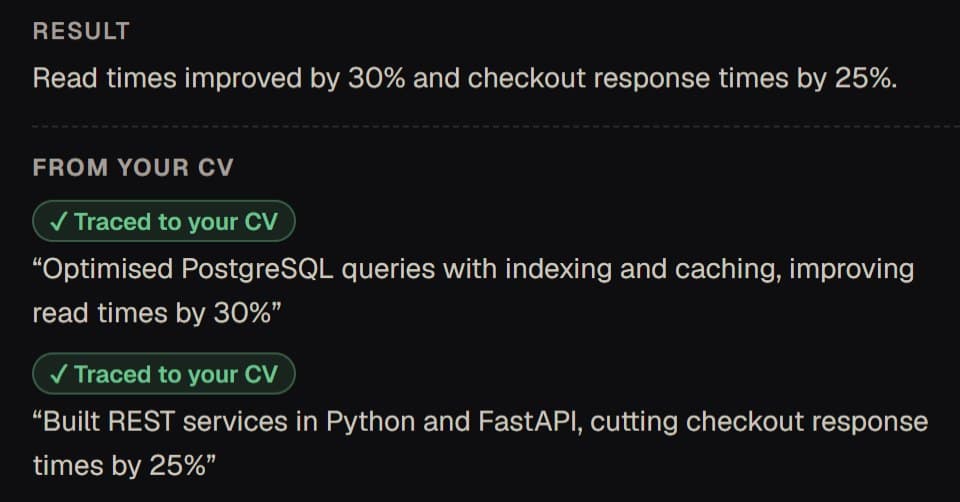
Interview answers traced, line by line, to your CV.
An interview pack for the job: the questions it will ask, STAR answers built only from your CV, and every line marked as traced to your CV or flagged for you to rephrase.
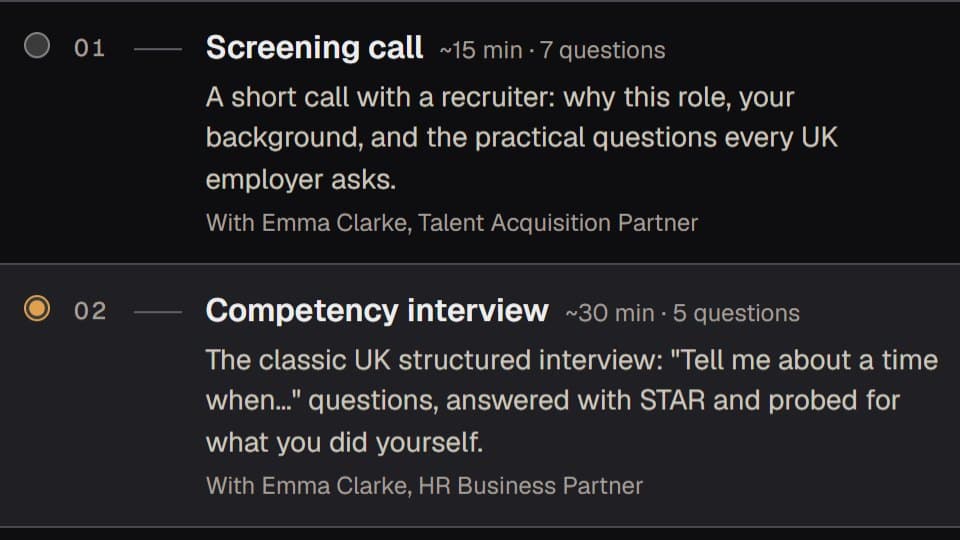
Then a UK interview, out loud.
Pick the round — screening, competency, strengths-based, technical, hiring manager, final — and an interviewer built from the same job asks the questions aloud and checks each answer against your CV. In your browser; no video, no upload.
Built around one constraint: nothing invented.
Checked, not trusted
Every figure is checked against your CV, every skill against the level you set for it, and every sentence of the summary and letter against the line it came from. If the job wants something you don't have, you see the gap — we don't invent the skill.
It tells you when it's wrong
The score is a count of the job's key words that your CV has. It is never an inflated percentage. Your applications list then shows whether higher scores really get further, and says so plainly when they do not.
Your applications, in one list
Click Applied and it is saved to your applications list: the exact CV you sent, the job description, and a follow-up date.
Free to start. Honest about what happens after.
- 3 free tailored CVs. No payment card needed.
- Your first 3 tailored CVs are free. That is 3 in total, not 3 a day. Each one comes with a cover letter and a keyword score. They are written by Claude (an AI model), and we pay for it.
- The daily limit
- 3 tailored CVs a day. The limit is the same on the free ones and on your own free AI account.
- After that: a free AI account
- Connect a free AI account in about 2 minutes and keep tailoring at no cost. Settings shows each step. The account is with OpenRouter, a service with free AI models. One honest note: OpenRouter's free models may train on what you send. Settings says how to check that in your OpenRouter account.
Honest beats impressive.
A CV with ten skills you can defend beats one with twenty that fall apart under questioning.
Tailor my CV →